Data & Feature Engineering
Defining success metrics, then gathering and engineering features from your data and sensor streams — usually the step that decides whether the rest of the project succeeds.
PandasNumPyAugmentation

We build and train custom AI models for organisations that have data and a problem but no in-house machine learning team — and, just as often, for teams whose model works in a notebook but not on the device. Our Vadodara engineers cover the full path: data and feature engineering, model development, training and optimisation, and integration into a product that has to keep working.
Defining success metrics, then gathering and engineering features from your data and sensor streams — usually the step that decides whether the rest of the project succeeds.
Models designed for your problem rather than pulled off a shelf — classification, regression, detection and segmentation, using CNNs, transformers or transfer learning as the data warrants.
Training runs with hyperparameter tuning and honest evaluation against metrics agreed up front, so performance claims mean something outside the training set.
Detection, segmentation and image analysis built on OpenCV and PyVision, including work on medical images where annotation quality matters as much as architecture.
Tuning, quantisation and acceleration for the target hardware — GPU, edge or embedded — with export to runtimes such as TorchScript and ONNX.
Deploying models into real products — embedded, edge, on-premise or cloud — with monitoring, versioning and the reliability our customers expect.
Most models that fail in production do so for reasons visible at the start: unclear success criteria, data that does not represent deployment, or a target platform nobody costed. We work through those in order.
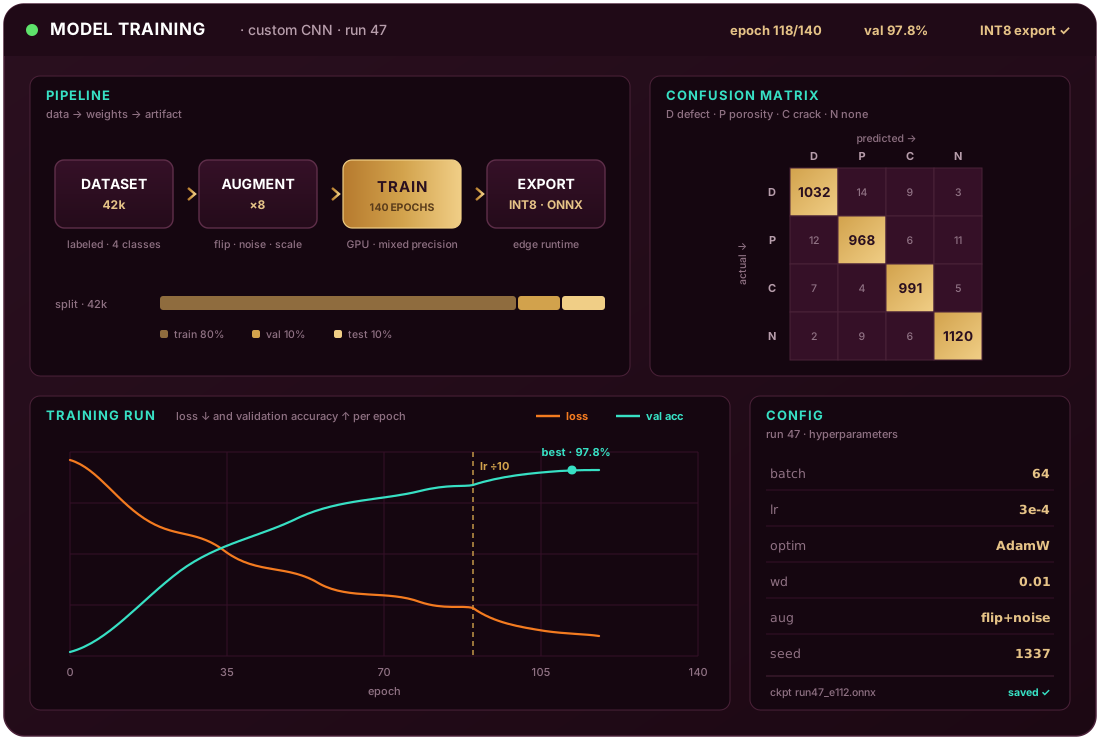
Including the pipeline, not just the weights — a model you cannot retrain is a liability once your data changes.
Our engineering team works from two hubs: an engineering office in Vadodara, Gujarat and headquarters in Silicon Valley. Most day-to-day design and verification work is carried out by the Vadodara team, which means clients across India — in Bangalore, Hyderabad, Pune, Delhi NCR, Ahmedabad and beyond — get direct access to the engineers doing the work, in the same time zone, at competitive rates — while the US office keeps the programme close to customers in North America.
India — Engineering Office: 301-306 (3rd Floor), Ozone, Sarabhai Road, Vadodara, Gujarat 390023 ·
+91 265 3100926 ·
contact@awengworks.in
USA — Headquarters: 1307 S. Mary Ave., Suite 260, Sunnyvale, CA 94087
It depends more on how representative the data is than how much there is. The first thing we do is assess what you have against the problem you want solved, and say plainly if the answer is that you need to collect more first.
Usually yes, and it is a large part of what we do. Getting a model inside an embedded power and latency budget means quantisation and export to a runtime like TorchScript or ONNX, and treating inference cost as a hardware requirement.
Yes. AI-assisted imaging is an active area for us, including segmentation and automated measurement. Where a model contributes to a clinical decision it becomes part of the regulated device, so training data, validation and change control need documenting accordingly.
In our Vadodara engineering office at Ozone, Sarabhai Road, Gujarat 390023, with headquarters in Sunnyvale, California.
Tell us what you are trying to predict, detect or measure, and we will tell you honestly whether machine learning is the right tool for it.