Low-Noise Front Ends
Receive-path design where the noise floor is the specification — gain distribution, impedance matching and layout treated as one problem rather than three separate ones.
Noise floorGain stagingMatching

Low-noise analog front-end and mixed-signal design, from the sensor or transducer through conditioning and data conversion into the digital domain. This is the part of a system that decides what information exists at all — no amount of processing downstream puts back what the front end discarded.
Receive-path design where the noise floor is the specification — gain distribution, impedance matching and layout treated as one problem rather than three separate ones.
Transducer selection, characterisation and front-end matching across linear, curved and phased-array probes, so the electronics suit the device actually being driven.
ADC selection and the design around it: sample rate and resolution chosen against the dynamic range the application genuinely needs, plus clocking and reference integrity.
Drive and pulse-shaping design on the transmit side, including the safety and acoustic output constraints that apply when energy is put into a patient or a part.
Budgeting the whole chain before parts are chosen, so the finished system meets its measurement requirement rather than discovering a shortfall at integration.
Supply and reference design, grounding and partitioning, and keeping switching noise out of the receive path where analog and digital have to share a board.
Front-end mistakes surface late and cost the most, because they present as image or measurement quality problems no algorithm can fix. Discovering one usually means a board respin, so we would rather spend the effort before layout.
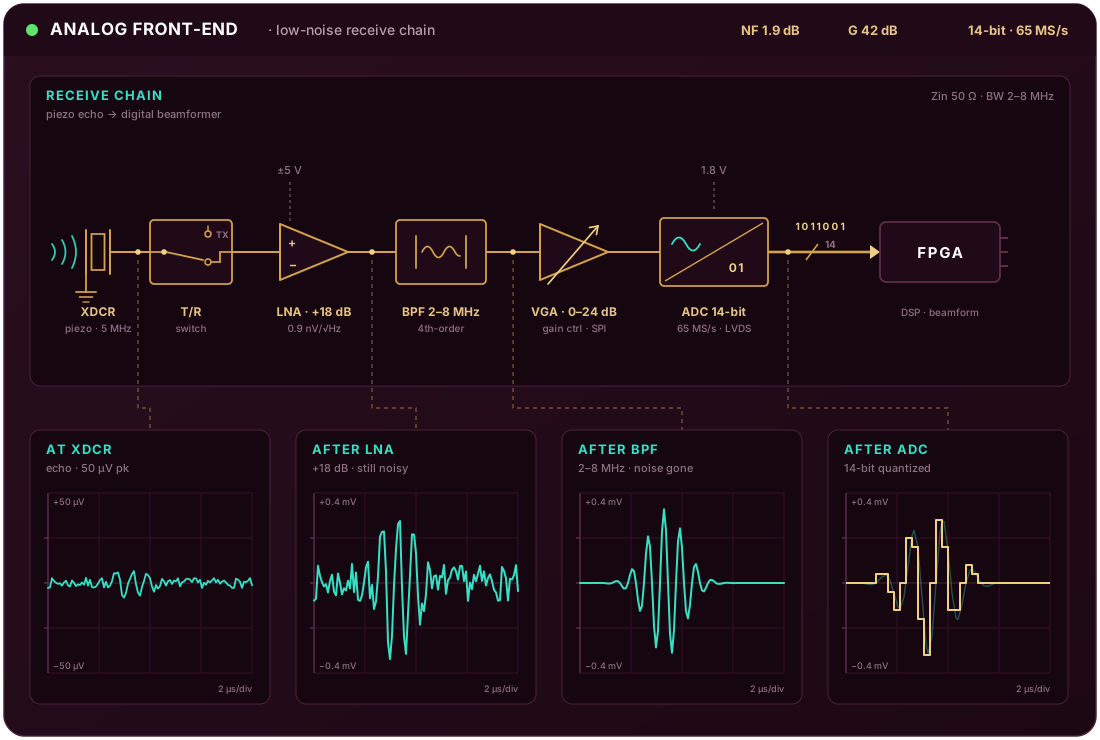
Enough analysis and evidence that the front end can be trusted before the rest of the system is built on top of it.
Our engineering team works from two hubs: an engineering office in Vadodara, Gujarat and headquarters in Silicon Valley. Most day-to-day design and verification work is carried out by the Vadodara team, which means clients across India — in Bangalore, Hyderabad, Pune, Delhi NCR, Ahmedabad and beyond — get direct access to the engineers doing the work, in the same time zone, at competitive rates — while the US office keeps the programme close to customers in North America.
India — Engineering Office: 301-306 (3rd Floor), Ozone, Sarabhai Road, Vadodara, Gujarat 390023 ·
+91 265 3100926 ·
contact@awengworks.in
USA — Headquarters: 1307 S. Mary Ave., Suite 260, Sunnyvale, CA 94087
Everything between the sensor or transducer and the first digital sample: low-noise amplification and gain control, filtering and conditioning, impedance matching, data conversion, and the clocking and supply design around it.
Yes. Transducer selection, characterisation and front-end matching across linear, curved and phased-array probes is core work for us, alongside transmit and receive beamforming.
Yes. A design review against a noise and dynamic range budget is a common, contained piece of work, and often the cheapest way to find out whether a measurement shortfall is fixable in software or not.
In our Vadodara engineering office at Ozone, Sarabhai Road, Gujarat 390023, with headquarters in Sunnyvale, California.
Whether you are choosing a converter, matching a new transducer, or designing a receive path from scratch, tell us the measurement you need and we will work back from there.