Instrument & Clinical UIs
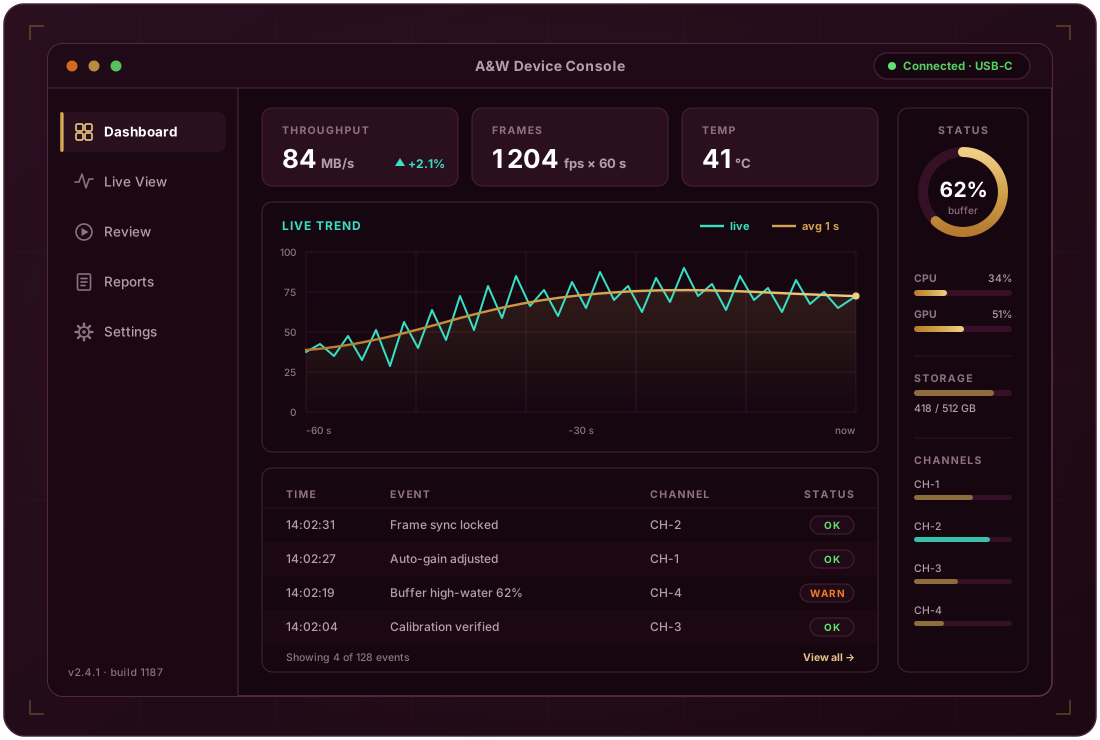
Interfaces for devices that operators and clinicians use all day — guided workflows, imaging displays, measurements and annotations, designed around the task rather than the database schema.
WorkflowsImaging UIUsability

The software a person actually touches — instrument and clinical user interfaces, desktop applications that control devices, and the review, reporting and analysis tools around them. Built by the same team that designs the hardware underneath, so device control, live data and performance are native to the application rather than bolted on.
Interfaces for devices that operators and clinicians use all day — guided workflows, imaging displays, measurements and annotations, designed around the task rather than the database schema.
Cross-platform desktop software in C++ and Python that stays responsive with live data streaming through it — the application layer for instruments, consoles and lab tools.
Plots, images and dashboards that keep up with the acquisition hardware — streaming waveforms, imaging pipelines and review tools rendered at interactive rates.
The layer that talks to the hardware — USB, Ethernet, serial and custom protocols. With the firmware team in the next room, when a protocol needs to change we change both sides of it.
Bring-up consoles, production test sequences and calibration tools — the internal software that decides whether a product can actually be built and verified in volume.
Application software developed under medical-device discipline — documented requirements, risk analysis and verification aligned with IEC 62304 when the software is part of a regulated device.
Application software for an instrument succeeds or fails on how well it understands the system underneath — the data rates, the timing, the failure modes. We build the application and the device as one programme, so neither has to guess about the other.
What leaves our office at the end of a piece of application work. The exact set depends on scope, and we agree it in writing before starting rather than at handover.
Our engineering team works from two hubs: an engineering office in Vadodara, Gujarat and headquarters in Silicon Valley. Most day-to-day design and development work is carried out by the Vadodara team, which means clients across India — in Bangalore, Hyderabad, Pune, Delhi NCR, Ahmedabad and beyond — get direct access to the engineers doing the work, in the same time zone, at competitive rates — while the US office keeps the programme close to customers in North America.
India — Engineering Office: 301-306 (3rd Floor), Ozone, Sarabhai Road, Vadodara, Gujarat 390023 ·
+91 265 3100926 ·
contact@awengworks.in
USA — Headquarters: 1307 S. Mary Ave., Suite 260, Sunnyvale, CA 94087
Yes. Workflow and screen design are part of the work, not a hand-off from someone else's mock-ups. We prototype the workflow early, put it in front of the people who will use it, and iterate before committing the implementation.
Yes. We regularly integrate against existing devices and protocols. If the firmware needs to evolve alongside the application, we can take both sides of the interface or work directly with your firmware team.
Yes. Where the application is part of a medical device we work to medical-device discipline — documented requirements, risk analysis and verification aligned with IEC 62304 — so the software can stand up in a regulatory submission.
In our engineering office at Ozone, Sarabhai Road, Vadodara, Gujarat, with company headquarters in Sunnyvale, California. Clients across India work directly with the Vadodara team.
From instrument consoles to clinical review tools — tell us what the software has to do and what it has to talk to, and we will tell you honestly how we would build it.